
What a care label promises, and why it might say dry clean
The small label beside the fibre label usually carries a row of five shapes: a washtub, a triangle, a square, an iron and a circle. Each stands for a stage of cleaning, and the marks inside or across it say how far that stage can go. Who decides what they mean, and what a maker must be able to back up, depends on where the garment is sold.
Five shapes
On GINETEX's chart of the international set, the washtub is washing. A number inside it is the highest water temperature in degrees Celsius, not to be exceeded. One bar underneath asks for a milder cycle with less agitation, and two bars a very mild one, the kind used for woollens. A hand in the tub means wash by hand. A cross through any of the five shapes means do not.
The triangle is bleach. Left empty, any bleach can be used. With two diagonal lines inside, only oxygen bleach, never chlorine.
The square is drying. A circle inside it means a tumble dryer, and the dots inside the circle show how much heat it can take. Lines inside the square mean drying without a machine: a vertical line for hanging on a line, a horizontal one for laying flat, and an added diagonal line for drying in the shade.
The iron is ironing. One dot is a low setting, three is hot.
The circle is for professional cleaners. The letter inside tells a dry cleaner which solvents are safe, and a bar beneath asks for a gentler process. A circle with a W covers professional wet cleaning, done with equipment a home machine cannot match. In the United States the FTC says a label reading "Professionally wetclean" does not comply with its rule.
Who owns the shapes
The system was devised by GINETEX, an association founded in Paris in 1963. Its symbols are registered trademarks in most countries and may not be used "without a special license agreement". One GINETEX page names a co-owner, COFREET, the French care-labelling committee; others name GINETEX alone. The symbols are also the origin of the international standard, ISO 3758, whose fourth edition was published in December 2023.
GINETEX's own brochure says care labelling "is mostly voluntary, however it can also be legally required". In the United States it is required: the Federal Trade Commission's Care Labeling Rule requires manufacturers and importers to give regular care instructions, on a label that stays attached and legible for the useful life of the garment.
American labels may replace words with symbols only from the 1996 edition of a guide by ASTM, which the rule names as the American Society for Testing and Materials. The FTC calls those symbols "similar, but not identical" to the international set. It proposed allowing the ISO symbols in 2012, then in 2020 proposed repealing the rule altogether.
The repeal "received little support", and on 21 July 2021 the FTC said it would not finalise it. In December 2023 it closed the whole review, the 2012 proposal included, without amending the rule.
Even the letters move. On a chart of the 1996 American symbols distributed by Textile Industry Affairs, a circled P means any solvent except trichloroethylene. The FTC's 2012 notice describes the same symbol as any solvent except perchloroethylene. The two accounts disagree, and the FTC adds that the 2007 revision made it perchloroethylene or petroleum. On GINETEX's chart, P means perchloroethylene and hydrocarbon solvents, which it glosses as "heavy benzines" and the American charts call petroleum.
The most it will take
The international symbols describe a ceiling. The ISO standard's summary says they give "information on the most severe treatments that do not cause irreversible damage". GINETEX adds: "Milder treatments and lower temperatures than those indicated on the label are always permitted." A 40 in the washtub is not a request for 40°C. It is the hottest wash the maker will stand behind.
Under the FTC's rule, American labels are read partly through their silences. "Machine wash" with no temperature means hot water up to 63°C (145°F) can be used regularly. Saying nothing about bleach means any commercially available bleach is safe. "Tumble dry" on its own means any dryer setting. Ironing has to appear only if the garment regularly needs it, or if an iron would harm it.
GINETEX also states that care labelling "is not a guarantee of quality", and that following it does not guarantee every stain will come out.
What the maker has to be able to back up
Under the American rule, a manufacturer must have a "reasonable basis" for every care instruction before sale: reliable evidence that the garment was not harmed when cleaned reasonably often as the label says, silences included, or that the methods it warns against do cause harm. Tests count, and so do "current technical literature, past experience, or the industry expertise". The FTC says experience is enough in some cases, while a dye known to bleed may call for test results.
What it is allowed to leave out
A label needs only one cleaning method. The rule is plain: "If either washing or drycleaning can be used on the product, the label need have only one of these instructions." Nor does it have to warn against the alternative. A label that says dry flat need not add do not tumble dry.
Some things need no sewn-in label at all. The rule does not cover footwear, gloves or hats, and the FTC also excludes handkerchiefs, belts, suspenders and neckties. A garment that survives the harshest washing, drying, ironing, bleaching and dry cleaning can carry "wash or dry clean, any normal method" on a hang tag instead.
Dry clean, and dry clean only
In 2000 the FTC set out the difference: a garment "legally labeled with a 'Dryclean' instruction alone may also be washable, but the manufacturer is not required to provide that additional information". "Dryclean Only" is different. It is a warning that the garment cannot be washed, and the FTC says it may be used "only if you have evidence that washing will damage the garment".
The usual solvent has a history of its own. In 2000 the FTC called perchloroethylene the most common dry-cleaning solvent, one Congress had designated a hazardous air pollutant. In December 2024 the US Environmental Protection Agency set a ten-year phase-out of its use in dry cleaning, and in July 2025 it began reconsidering that rule. As of 2 October 2026 its page shows a July 2026 extension of some workplace deadlines and still gives the ten-year phase-out; the reconsideration has no outcome yet.
Whether dry clean is often just the cautious choice was argued over in an FTC proceeding that ran from 1994 to 2000. Consumers, academics and an appliance makers' association told the Commission that many manufacturers labelled washable items dry clean. The FTC found "evidence in the record that some garments labeled 'Dryclean,' or even 'Dryclean Only,' are in fact home washable". Silk, wool and rayon were the fabrics mentioned most often, though weave and dyes also affect whether a cloth washes well.
The American Apparel Manufacturers Association argued the other side: "Responsible apparel firms label their garments according to what they believe to be the best method of cleaning." It warned of returns and "consumer anger at prematurely worn-out clothes" if garments that should "ideally be dry cleaned" were labelled for home washing.
The FTC declined to require washing instructions. It was "not convinced" the evidence was "sufficiently compelling", and called the benefits "highly uncertain". Some labels give both methods and add "For best results, dryclean", which the FTC accepts, if true and substantiated, as saying the garment washes without damage but may look and last better dry cleaned.
What the proceeding never established is how many garments labelled dry clean could safely be washed at home. The FTC said its record did not show it, and that without a standard for a successful home wash there is a "gray area" where "deference would have to be accorded the manufacturer's best judgment".
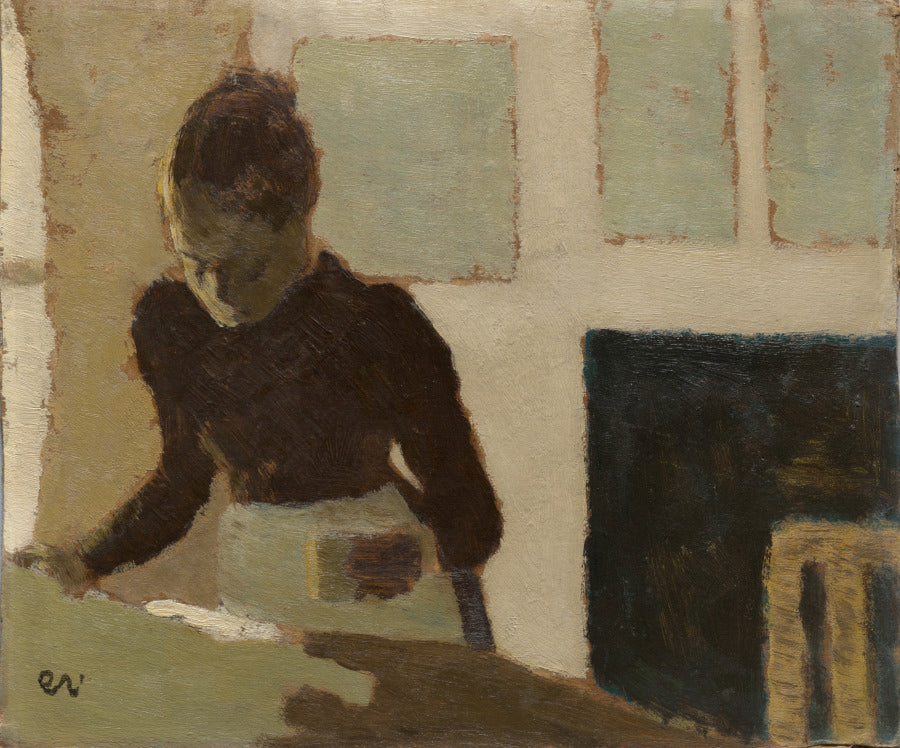
Image: Édouard Vuillard, Woman Ironing, 1892, oil on board. The Cleveland Museum of Art, Nancy F. and Joseph P. Keithley Collection Gift, 2020.119. Released by the museum under CC0. https://clevelandart.org/art/2020.119
Sources
Everything above that is a claim about the world rather than about us is checkable here. If we have got something wrong, we would like to know.
- Electronic Code of Federal Regulations, 16 CFR Part 423, Care Labeling of Textile Wearing Apparel and Certain Piece Goods as Amended (current to 29 September 2026). Definitions in §423.1, unfair practices in §423.5, washing, drying, ironing, bleaching, warnings and reasonable basis in §423.6, exemptions and ASTM symbols in §423.8
- Federal Trade Commission, Clothes Captioning: Complying with the Care Labeling Rule (business guidance, May 2014), including the FAQ on "Professionally Wetclean"
- Federal Trade Commission, Trade Regulation Rule on Care Labeling of Textile Wearing Apparel and Certain Piece Goods, final amended rule, 65 FR 47261 (2 August 2000), section II.C, "Proposal to Require Home Washing Instruction", pp. 47267 to 47271
- Federal Trade Commission, Trade Regulation Rule on Care Labeling of Textile Wearing Apparel and Certain Piece Goods, notice of proposed rulemaking, 77 FR 58338 (20 September 2012), discussion of ASTM and ISO symbols at p. 58346
- Federal Trade Commission, Care Labeling Rule: final determination, termination of rulemaking, 88 FR 85495 (8 December 2023), including the 21 July 2021 decision not to finalise the repeal
- International Organization for Standardization, ISO 3758:2023, Textiles: Care labelling code using symbols, edition 4 (abstract page; the standard itself is paywalled and only the abstract is relied on here)
- ASTM International, D5489 Standard Guide for Care Symbols for Care Instructions on Textile Products, current edition D5489-25 (abstract and significance statement; the standard itself is paywalled)
- Textile Industry Affairs, Guide to Apparel/Textile Care Symbols (chart TIA-GTATCS-050608, "referenced from ASTM D5489-96c, Fig. 1"), archived copy of 6 March 2009
- GINETEX, Care labelling: basic principles
- GINETEX, Care symbols: existing care symbols under ISO 3758:2023 (descriptions and symbol chart)
- GINETEX, Who we are
- GINETEX, Textile Care Symbols (brochure, undated PDF), "Basic principles", "Labelling" and the list of national committees
- US Environmental Protection Agency, Risk Management for Perchloroethylene (PCE), read 2 October 2026
- The Cleveland Museum of Art, Édouard Vuillard, Woman Ironing, 1892, object record 2020.119

